Summary
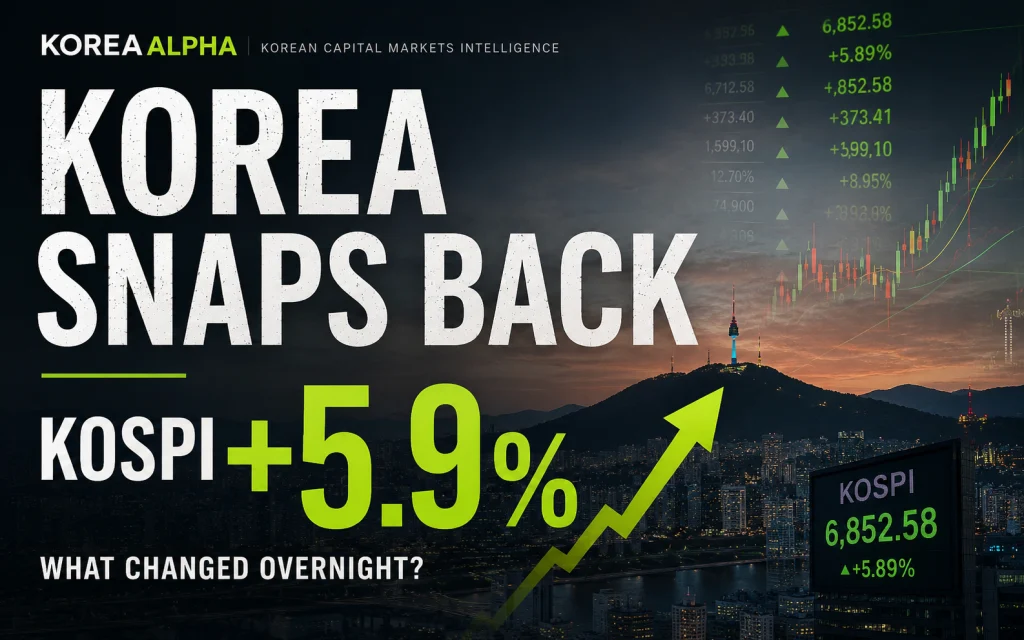
Korea’s stock market staged a dramatic reversal, with the KOSPI surging 5.9% just one day after a sharp selloff.
Semiconductor heavyweights led the rebound as investor sentiment improved and attention shifted toward shareholder returns, global rates and foreign capital flows.
But a rebound this powerful raises a bigger question: did Korea’s fundamentals change overnight — or is the market revealing just how sensitive it has become to a handful of powerful forces?
Key Takeaways
- ✓ Korea’s market reversed sharply, with the KOSPI jumping 5.9% just one session after a steep selloff.
- ✓ Semiconductor heavyweights led the rebound, reinforcing how strongly Korea’s major indices remain tied to the chip cycle.
- ✓ Shareholder-return expectations helped improve sentiment, with SK hynix at the center of the market’s attention.
- ✓ The speed of the rebound does not necessarily mean the risks behind the previous selloff have disappeared.
- ✓ Global rates, foreign investor flows and semiconductor fundamentals remain key signals for determining whether the rebound can hold.
What Happened
Korea’s equity market reversed sharply just one session after its steep selloff, with the KOSPI surging 5.9% as investors moved back into some of the market’s largest semiconductor names.
SK hynix and Samsung Electronics were at the center of the rebound, while improving risk sentiment and renewed attention to shareholder returns helped accelerate the recovery.
The move effectively retraced much of the previous session’s decline, producing an unusually sharp two-day swing in one of Asia’s largest equity markets.
What changed was not simply the direction of the index. The same heavyweight stocks that amplified the selloff became the engines of the rebound.
Why It Matters
Korea’s sharp rebound highlights the same structural feature exposed by the previous session’s selloff: a relatively small group of heavyweight companies can have an outsized influence on the direction of the broader market.
When semiconductor leaders fall sharply, the index can decline faster than underlying conditions across the wider economy might suggest. When those same stocks rebound, the effect can work just as powerfully in the opposite direction.
That makes headline index moves harder to interpret in isolation. A 5.9% rebound may signal improving sentiment, but it does not necessarily mean that the macroeconomic and market risks behind the previous selloff have disappeared.
For global investors, the key question is therefore not simply whether the KOSPI is rising or falling, but what is driving the move — and whether semiconductor earnings, foreign capital flows and global financial conditions support it.
Korea’s 5.9% rebound is less a signal that risk has disappeared than a reminder of how quickly concentrated leadership can move the entire market. The next test is whether semiconductor earnings, foreign flows and global financial conditions can turn a sharp technical reversal into a more durable recovery.